
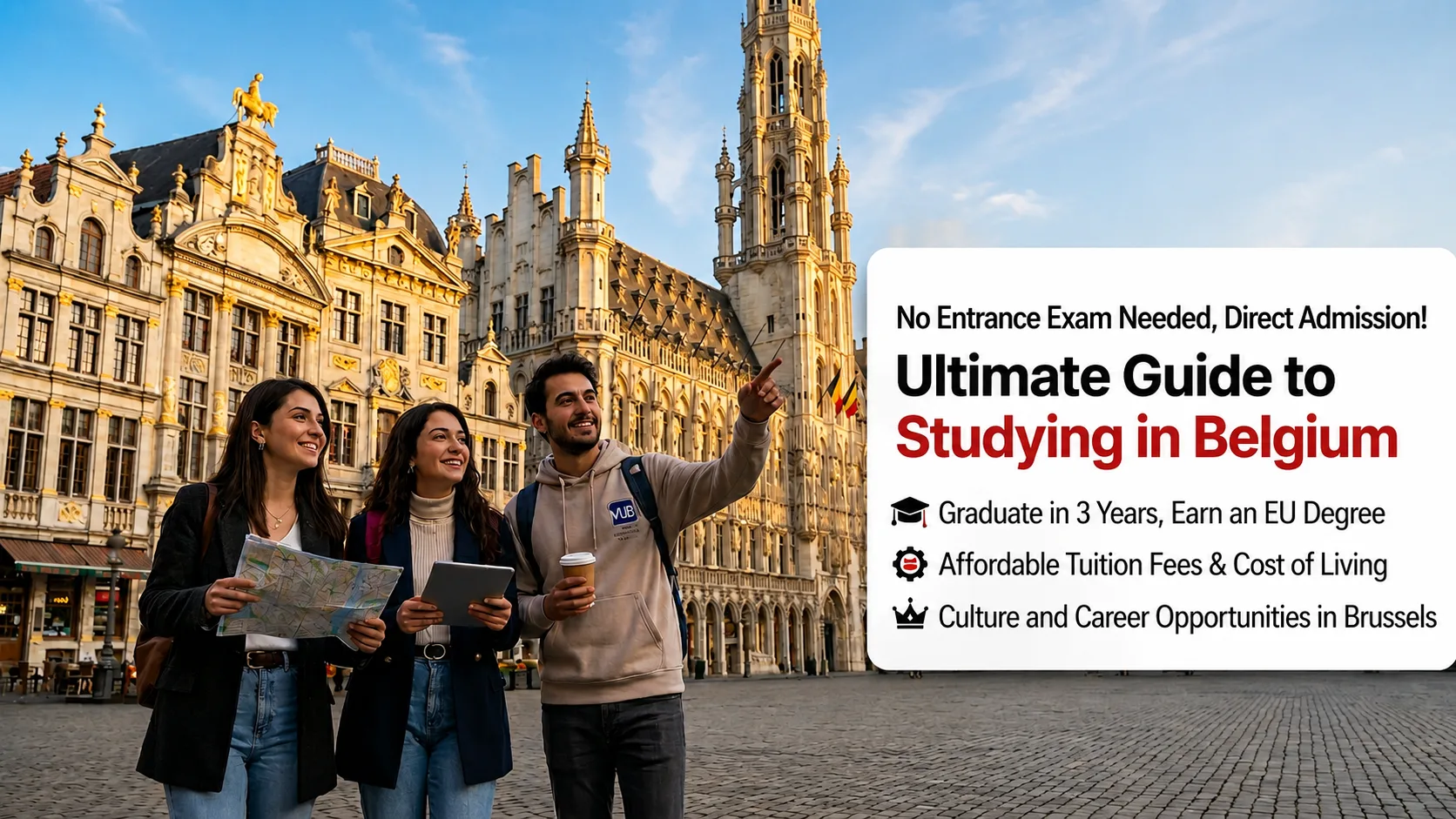
Get a European Degree Without Entrance Exams: Study in Belgium
High School Education in Belgium
For international students, high school options are generally divided into three categories:
1. Public High Schools (Exchange Programs): These are schools attended through cultural exchange programs (such as AFS, YFU, etc.) that typically last for one academic semester or one full year. Students live with a local host family and adapt to the local language of instruction (French or Dutch). It is an excellent way to experience the culture firsthand.
2. Private Boarding Schools: These are prestigious institutions offering full-time education and accommodation for international students. Guidance, supervision, and student support in these schools are maintained at the highest standards.
3. International Schools: Concentrated mainly in and around Brussels, the medium of instruction at these schools is usually English. They implement world-renowned curricula such as the International Baccalaureate (IB) or American/British systems. It is ideal for students who plan to continue their higher education in countries like the UK, the USA, or Canada.
Bachelor's and Master's Admission Requirements
Undergraduate education in Belgium is conducted under the framework of the Bologna System and is fully compatible with the European higher education structure. A Bachelor's degree is typically structured to last 3 years (180 ECTS). While certain scientific and technical fields may have a more intensive program structure, this setup allows students to complete their degree in just 3 years, unlike the standard 4-year education system in Turkey.
Higher education programs are broadly split into two main institutional types:
Universities: Offer a more academic and theory-oriented education.
Universities of Applied Sciences (Hogeschools): Focus on practical, profession-oriented skills and hands-on training.
The educational landscape is divided by the country's two main regions: the Flemish Region (predominantly Dutch-taught) and the Walloon Region (predominantly French-taught). Naturally, hundreds of English-taught programs are available across both regions.
For Undergraduate (Bachelor's) Programs:
Diploma Equivalence: Your high school diploma must be officially recognized and approved by the Belgian authorities (a process known as denklik or équivalence). Because this evaluation can take up to a few months, submitting an early application is critical.
Language Proficiency: For English-taught programs, an IELTS (usually a minimum score of 6.0 - 6.5) or an equivalent TOEFL score is required. For programs taught in French or Dutch, a minimum proficiency level of B2 is expected.
Entrance Exams: Specific entrance examinations (or ranking exams) are mandatory for fields such as medicine, dentistry, engineering, and certain fine arts departments.
For Graduate (Master's) Programs:
Related Bachelor's Degree: The department you apply to must be directly or closely related to your undergraduate degree field.
Academic Success (GPA): Holding a high Cumulative Grade Point Average (CGPA) directly enhances your chances of admission.
Required Documents: A compelling motivation letter, academic reference letters, and an up-to-date CV.
2. Tuition Fees
For international students coming from outside the European Union (non-EU), tuition fees vary based on the chosen region and university:
Flemish Region: Annual tuition fees are generally more standardized, ranging on average between €2,500 and €8,000.
Walloon Region: A fixed specific supplementary fee applies to non-EU students. On average, annual undergraduate and graduate tuition fees range from €4,175 to €12,500.
💡 Note: While fees for certain prestigious business schools or specialized private programs can be significantly higher, public universities in Belgium remain highly economical compared to those in the US or the UK.
3. Financial Proof (Blocked Account Details)
The most critical requirement for securing a Belgian student visa (Schengen Type D Visa) is officially proving that you can cover your educational and living expenses. The Belgian government updates the minimum required monthly subsistence amount for students on an annual basis.
Required Amount: You must prove a budget of approximately €800 to €1,000 per month (totaling roughly €10,000 to €12,000 for a 1-year academic period).
Methods of Proof:
Blocked Account: This is the most common and guaranteed method. You transfer the required funds to your Belgian university’s designated bank account. After you receive your visa, the university pays this money back to you in regular monthly installments (e.g., €850 per month) like a student salary.
Sponsor (Guarantor): A relative living in Belgium or your home country who possesses a regular, high-level income signs a formal commitment to sponsor your stay.
Scholarship: An official document proving that you have been awarded a scholarship from an institution or an official fund.
4. Cost of Living
Student life in Belgium is moderately priced by Western European standards. Expenses are slightly higher in the capital city of Brussels, whereas costs are lower in dedicated student cities like Leuven or Ghent.
Expense Item
Average Monthly Cost
Accommodation (Student Dorm / Shared Apartment) €400 - €700
Groceries & Food €200 - €300
Transportation (With Student Discount Pass) €20 - €50
Social Activities & Personal Expenses €150 - €250
Total Estimated Budget €800 - €1,300 / Month
5. Working Rights
Belgium legally permits international students to work, making it easy to earn pocket money and step into the professional world.
Working Rights During Studies:
As long as you hold a valid student residence permit (A Card), you are legally allowed to work up to 20 hours per week while classes are in session.
During official school holidays (Summer break, Christmas, etc.), you can work full-time with no hourly limitations.
Post-Graduation (Orientation Year):
International students who successfully complete a Bachelor's or Master's degree in Belgium are granted a 12-month "Orientation Year" permit to search for employment or set up their own company.
During these 12 months, your right to work is entirely unrestricted. Once you secure a qualified job offer within this period, you can convert your residence permit directly into a professional work permit.
6. The Pathway to Citizenship After Graduation
For individuals looking to settle down and eventually acquire an EU passport after completing their education, Belgium offers a highly transparent and fair legal process:
Graduation and Employment: Once you secure a job during your orientation year that meets the legal minimum salary criteria for a Single Permit (Combined Work and Residence Permit), you can maintain your legal residency in Belgium.
Continuous Residence: The baseline requirement to apply for Belgian citizenship is having lived legally and continuously in the country for at least 5 years.
Counting Student Years: The way time spent as a student factors into the citizenship calculation can vary based on periodic legal updates; however, full-time years completed after transitioning into active professional working life form the primary basis.
Citizenship Criteria at the End of 5 Years:
Language Proficiency: Proving proficiency in one of the three official languages (French, Dutch, or German) at a minimum level of A2 via an official exam.
Economic Contribution: Demonstrating active participation in the Belgian economy by having worked for a specified duration within the last 5 years.
Social Integration: Showing clear social integration into the community and maintaining a completely clean criminal record.