
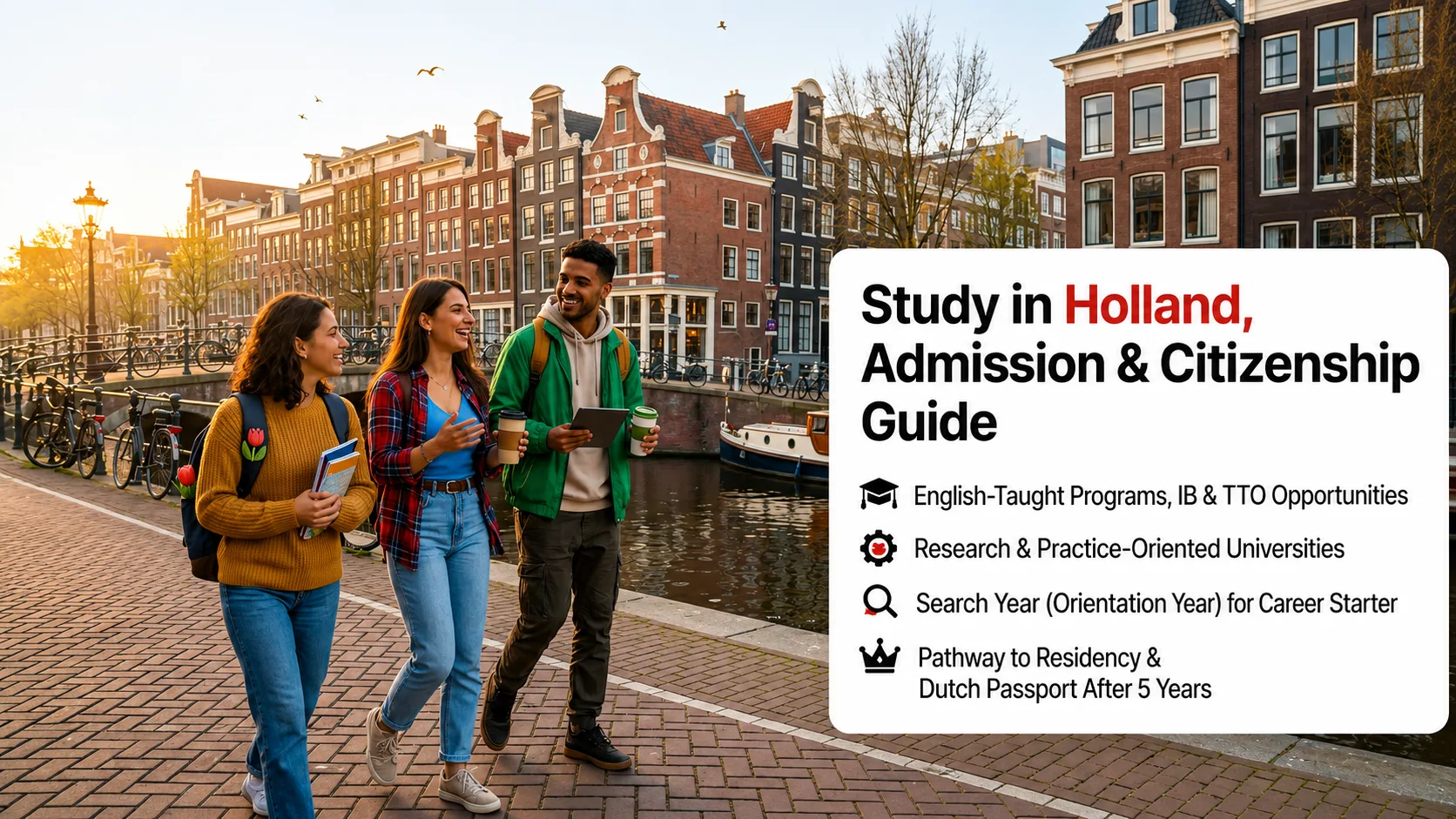
Study in the Netherlands: The Pathway from Higher Education to a European Passport
The Dutch High School Education System
High school education in the Netherlands moves away from rote memorization, focusing entirely on discovering and developing a student's individual talents and areas of interest. Based on exam results and teacher recommendations, students are guided into one of three primary secondary education tracks:
VMBO (Preparatory Secondary Vocational Education): This program lasts approximately four years. Graduates earn a vocational certificate.
HAVO (Senior General Secondary Education): This program lasts five years. Graduates gain the right to transition directly into Universities of Applied Sciences (Hogescholen), as this track specifically prepares students for higher professional education.
VWO (Pre-University Education): This program lasts six years and grants graduates direct access to prestigious Research Universities.
Options for International Students:
International Schools: The medium of instruction at these institutions is entirely English, and they offer the globally recognized IB (International Baccalaureate) diploma. Students receive an education at global standards within a multicultural environment. Designed for students aged 16–19, this universal two-year pre-university curriculum enhances academic and cultural background, carries immense international validity, and is recognized worldwide.
Bilingual Schools (TTO - Tweetalig Onderwijs): These public schools split their curriculum—teaching half of the courses in English and the other half in Dutch. It represents an excellent opportunity for students who want to adapt to the local culture while bringing their English language skills to a native-speaker level.
Higher Education in the Netherlands: Bachelor's, Master's, and Citizenship Guide
As one of Europe's most prosperous nations, the Netherlands ranks at the top of international students' preferences thanks to its high-quality educational opportunities and student-friendly cities. Dutch universities provide an exceptionally rich experience for both academic and personal growth. Because a vast majority of universities in the Netherlands offer English-taught undergraduate and graduate programs, it presents a massive opportunity for international students seeking a world-class degree in English.
Admission Requirements for Bachelor's and Master's Programs
Higher education institutions in the Netherlands are broadly divided into two categories: Research Universities (WO) and Universities of Applied Sciences (HBO). While the first category offers a theoretical and academic-heavy education, the second focuses entirely on practical skills and industry preparation. Generally, a degree at a Research University takes 3 years to complete, whereas a degree at a University of Applied Sciences takes 4 years.
Core Admission Criteria:
Academic Qualifications (Diploma): A high school diploma obtained from Turkey may not always be accepted for direct admission by every university. Research universities, in particular, often look for advanced academic credentials such as high AP scores, an IB diploma, or high placement scores in the Turkish national university entrance exam. For graduate admission, a Bachelor’s degree in a related field with a high Cumulative Grade Point Average (CGPA/GPA) is mandatory.
Language Proficiency: An official IELTS or TOEFL score is required for English-medium programs. Generally, undergraduate programs require a minimum IELTS score of 6.0 - 6.5, while graduate programs look for a score in the 6.5 - 7.0 band.
Motivation and Reference Letters: A sincere, compelling personal statement answering the questions "Why the Netherlands?" and "Why this specific program?", alongside a well-crafted CV and academic references from your professors, directly impacts your chances of acceptance.
Tuition Fees and Cost of Living
Tuition fees in the Netherlands vary depending on the student's citizenship status, the chosen university, and the specific program of study.
Average Tuition Fees:
Bachelor’s Programs: Ranges between €9,000 and €15,000 per year.
Master’s Programs: Ranges between €12,000 and €20,000 per year depending on the university and department (fees are typically higher for specialized medical fields or executive MBA programs).
Monthly Cost of Living:
Including accommodation, food, transport, and social activities, a student's average monthly living cost ranges between €1,000 and €1,500.
Visa Prerequisite: Financial Proof
The Dutch Immigration and Naturalisation Service (IND) requires international students to officially prove they have sufficient funds to cover their living costs during their studies.
The current monthly living cost standard set by the IND (excluding tuition fees) is €1,094.12 per month. This means that for a 1-year student visa, you must show a minimum cash balance of approximately €13,130 in your account as financial proof.
Working Rights During and After Studies
Pre-Graduation Working Rights:
Students from outside the EU/EEA are legally permitted to work part-time for up to 16 hours per week during the academic term. During official school holiday periods, they have the right to work full-time. However, to work legally, your employer must obtain a temporary work permit (TWV) on your behalf.
Post-Graduation (Orientation Year - Zoekjaar):
Upon successfully graduating from an undergraduate or graduate program in the Netherlands, the government grants international graduates a 1-year special residence permit called the "Zoekjaar" (Orientation/Search Year). This right can be exercised at any point within 3 years of graduation and provides the following benefits:
Graduates can work full-time, complete internships, or start their own company.
No separate work permit (TWV) is required.
There is no minimum salary threshold imposed during this year.
The Pathway to Dutch Citizenship
For individuals looking to build a permanent life in the Netherlands and acquire an EU passport, your student years form the absolute bedrock of the timeline. The primary route to citizenship is through the Naturalization process:
5 Years of Continuous Residence: You must live legally and continuously in the Netherlands for 5 years. Unlike many other European nations, the Netherlands fully counts time spent on a student visa toward this 5-year requirement. For example, if a student completes a 3-year Bachelor's degree, a 1-year Master's degree, and spends 1 year working, they officially complete their 5-year residency mark.
Integration and Language Exam (Inburgeringsexamen): Applicants must prove they have integrated into Dutch society. To achieve this, they must pass the civic integration exam, which tests knowledge of Dutch society and evaluates language proficiency (currently requiring at least an A2 level).
Economic Stability and Clear Record: At the exact moment of application, you must possess a valid employment contract, show a steady source of income, and have maintained a completely clean criminal record during your stay in the country.
The Dual Citizenship Exception: As a general principle, the Netherlands does not allow dual citizenship. Applicants are required to renounce their Turkish citizenship to acquire Dutch citizenship. (However, certain exceptions apply, such as being legally married to a Dutch citizen, which can allow you to retain dual nationality).