
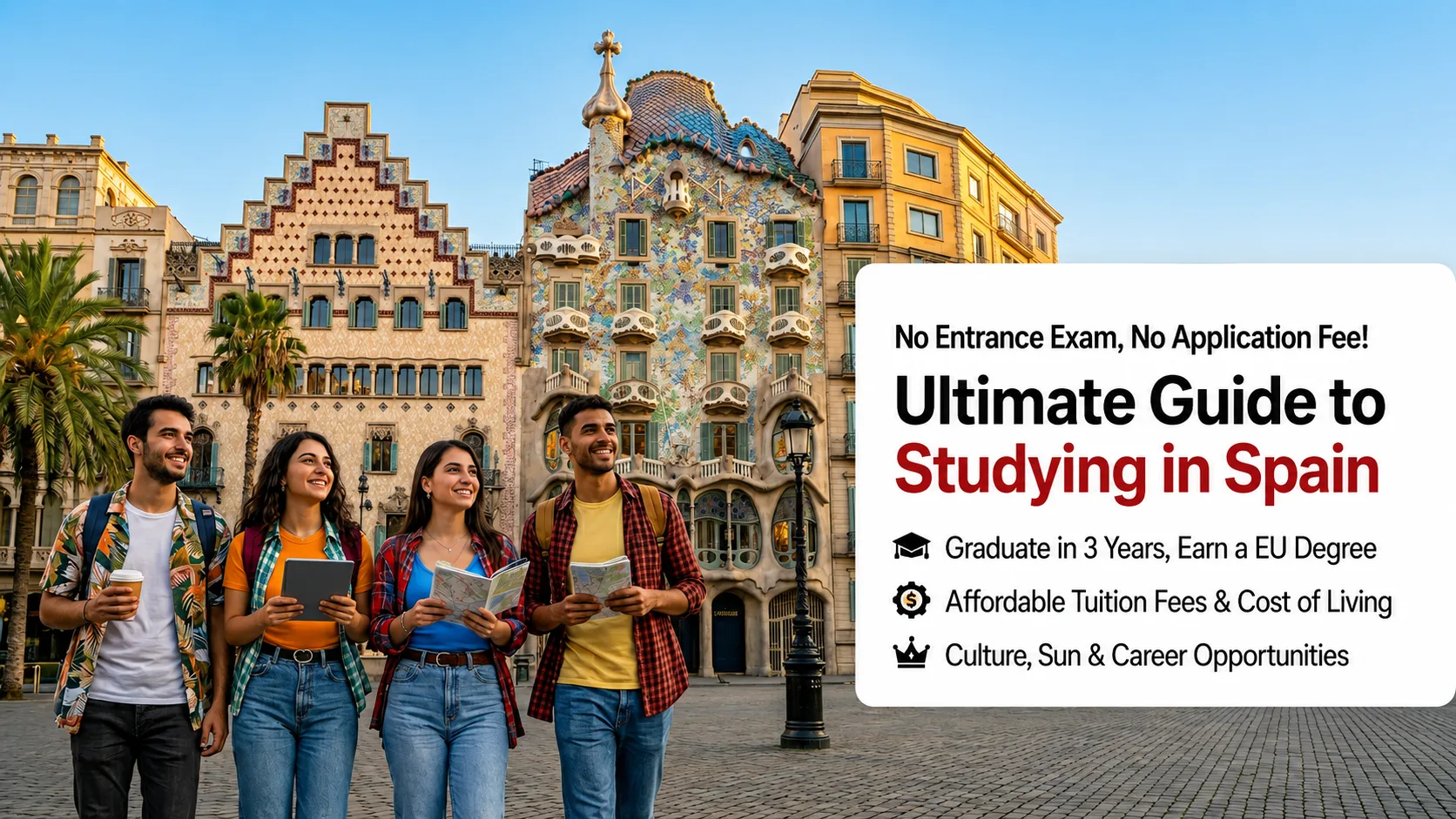
Sun, Culture, and Education: Studying at a University in Spain Without Entrance Exams!
Studying High School in Spain
High school education in Spain offers two primary tracks depending on the student's age and target diploma: Compulsory Secondary Education (ESO) for ages 12–16, and the university-preparatory Bachillerato (Spanish Baccalaureate) for ages 16–18. The Bachillerato spans 2 academic years, but options remain highly flexible for international students.
1. Educational System and Diploma Options
While the local high school track (Bachillerato) normally lasts 2 years, international students can choose between distinct pathways:
Local Curriculum (Bachillerato / Spanish Baccalaureate): Taking courses in Spanish offers complete "cultural adaptation." In Public Schools, the medium of instruction is predominantly Spanish, though regional languages may also be used depending on the area. Availability and admissions processes vary by region, meaning international enrollment does not always function as a standardized "package program."
International Baccalaureate (IB) or British Curriculum: Studying at private colleges that teach in English allows you to earn a globally recognized diploma. Private Schools charge tuition fees; some offer the Spanish curriculum, while others provide international tracks like the IB. International Schools stand out with English-medium education, recognized diploma options, and more structured admission procedures that clearly define English proficiency requirements, interviews, and academic assessments.
Higher Education (Bachelor's and Master's)
Because Spain is a member of the Bologna Process, its degrees are fully recognized across Europe and worldwide. Higher education is delivered through both public and private universities.
Bachelor's Degree (Grado): Typically lasts 4 years, requiring the completion of 240 ECTS credits. Specialized fields such as Medicine or Architecture can take 5 to 6 years.
Master's Degree (Máster Universitario): Lasts between 1 and 2 years (60–120 ECTS), depending on the intensity of the program.
Spain University Admission Requirements
For Undergraduate (Bachelor's) Programs:
Homologation (Diploma Equivalence): Your high school diploma must be officially recognized and approved by the Spanish Ministry of Education. This evaluation process can take several months.
Selectividad / PCE Exam: To study at a public university, international students must take the PCE (Pruebas de Competencias Específicas) exam.
Exceptions: Graduates from French, Italian, or German high schools can apply to Spanish universities without an equivalence process or taking the Selectividad (PAU) exam. Similarly, students graduating from high schools that award an EU-recognized International Baccalaureate (IB) diploma are also exempt from the Selectividad (PAU) exam.
Private Universities & Conditional Admission: Private institutions generally conduct their own internal interviews or exams. If a student meets all academic criteria but lacks language proficiency, they receive conditional admission. They must first travel to Spain to attend a language preparation course to reach a B2 level in Spanish, after which they can proceed to Selectividad (PAU) preparation courses.
Language Proficiency: For Spanish-taught programs, a minimum of a B2 DELE/SIELE certificate is required. For English-taught programs, you will need an IELTS (at least 6.0 - 6.5) or an equivalent TOEFL score.
For Postgraduate (Master's) Programs:
Bachelor's Diploma and Transcript: You must have graduated from a related field, and your documents must be translated and apostilled.
CV and Motivation Letter: A strong academic CV and a compelling personal statement explaining why you chose the specific program and Spain.
Letters of Recommendation: At least two reference letters from professors or former employers.
2. Financial Proof Details
When applying for a Spanish student visa (Visado de Estudios), you must officially prove you can support yourself financially. The Spanish government uses the IPREM (Public Multiple Effects Income Indicator) index as its benchmark.
Minimum Monthly Amount: The student must possess 100% of the IPREM value for each month of stay. While updated annually, this averages around €600 - €700 per month.
Annual Total: For a 1-year academic period, you must show an unblocked, legally source-verifiable cash balance of at least €10,000 - €12,000 in your bank account (or your sponsor's account). If tuition has already been paid, the payment receipt must be appended to your application file.
3. Tuition Fees and Cost of Living
Compared to other Western European destinations like the UK or France, Spain is remarkably cost-effective.
Tuition Fees
Public Universities: Annual fees vary by autonomous region. On average, undergraduate and graduate tuition ranges from €1,500 to €4,500 per year. Non-EU students may sometimes be subject to a higher "per-credit fee" rate.
Private Universities & Business Schools: Fees start at €6,000 and can exceed €20,000 per year.
Cost of Living
While metropolitan hubs like Madrid and Barcelona carry higher living expenses, cities like Valencia, Seville, or Granada are far more affordable.
Accommodation: Shared student rooms cost €300 - €500 per month, while individual apartments start at €700 and up.
General Expenses (Food, Transport, Utilities): Averages €300 - €400 per month.
Total Estimated Budget: Expect an overall living cost of €700 - €1,100 per month.
4. Working Rights: During and After Studies
Spain has recently introduced flexible regulations allowing international students to earn extra income and gain professional experience.
During Studies (Pre-Graduation): Your student visa allows you to work part-time for up to 30 hours per week, provided the job does not conflict with your university timetable.
Post-Graduation (Job Search Visa): Upon graduating from a Spanish higher education institution, you can apply for a 1-year Job Search Visa (Residencia para búsqueda de empleo) to find work or establish your own company. Once you secure a full-time job within this year, you can convert this status into a standard work permit.
5. The Pathway to Citizenship After Graduation
While studying in Spain is an incredible experience, there is a critical legal distinction you must know regarding long-term immigration:
Important Note: Time spent in Spain on a student visa (Estancia) does not count toward the continuous residency (Residencia) required for citizenship applications. Legally, a student visa is categorized as a temporary "stay" permit rather than permanent residency.
The Real Route to Citizenship:
Transition to a Work Permit: After graduation, you must secure employment and convert your student visa into a formal Residence and Work Permit (Residencia y Trabajo).
The Residency Clock Begins: Your official timeline toward citizenship starts ticking the exact day you receive your work permit (or another form of legal residency).
Citizenship Application:
For Turkish Citizens: You can apply for citizenship after living in Spain legally and continuously for 10 years under a qualifying residency/work permit.
Exceptions: The requirement drops to 1 year if you marry a Spanish citizen. (For citizens of Latin American countries, the baseline requirement is 2 years).
Integration and Language Exams: During the application phase, you must pass a basic Spanish language exam (DELE A2) and the Spanish culture and constitutional history test (CCSE).